Already Home: Why Your Body Doesn’t Know It’s on Vacation

The Provisions of Home
My perspective—you pack your laptop, yeah it’s cool to be able to lay on the beach and respond to emails or take your Teams meeting from your Airbnb with beautiful views of the city. These things are great when you have to work. Let’s say you have to submit a proposal. You proofread it on the plane. You make your edits during your layover. As soon as you check in you’re connecting your work laptop to the hotel WiFi. You have your emergency hotspot device in case the internet is bad. You get the roaming package for your cellular service. You’ve given yourself all the provisions of home.
So why even go on vacation?
You say you need it, you’ve been counting down. You’ve made arrangements with neighbors to get your mail. Dog sitters to walk the pups and water your plants. You put in your PTO request three months in advance. You’ve done it all on top of already being an exemplary employee.
So why is it so hard to detach, disconnect, disengage on home and work activities while on vacation?
What You Left Behind

You’re on the phone with coworkers back home wondering what’s been going on since you’ve been gone. You’ve been texting and chatting with friends and family at home. Not the check-ins to say you made it safely. But the constant engagement via text, via Facebook live. Sharing the vacation with the world. Instead of being present and engaged, you’re distracted by what you left back at home. The exact stressors you claimed you wanted to escape.
Your nervous system has not learned stillness—sometimes it doesn’t know rest or quiet. The very purpose of vacation is lost on anxiety-inducing familiar behaviors. Family drama, accepting calls or involving yourself in the “he said this, she did this” with relatives. So instead of enjoying the sun, your nervous system is hyper-focused on the next text. Will it be sister one or sister two? Instead of detaching from work, your nervous system is curious about who is doing your job and how they can’t do it like you, or how the staff is surviving in your absence.
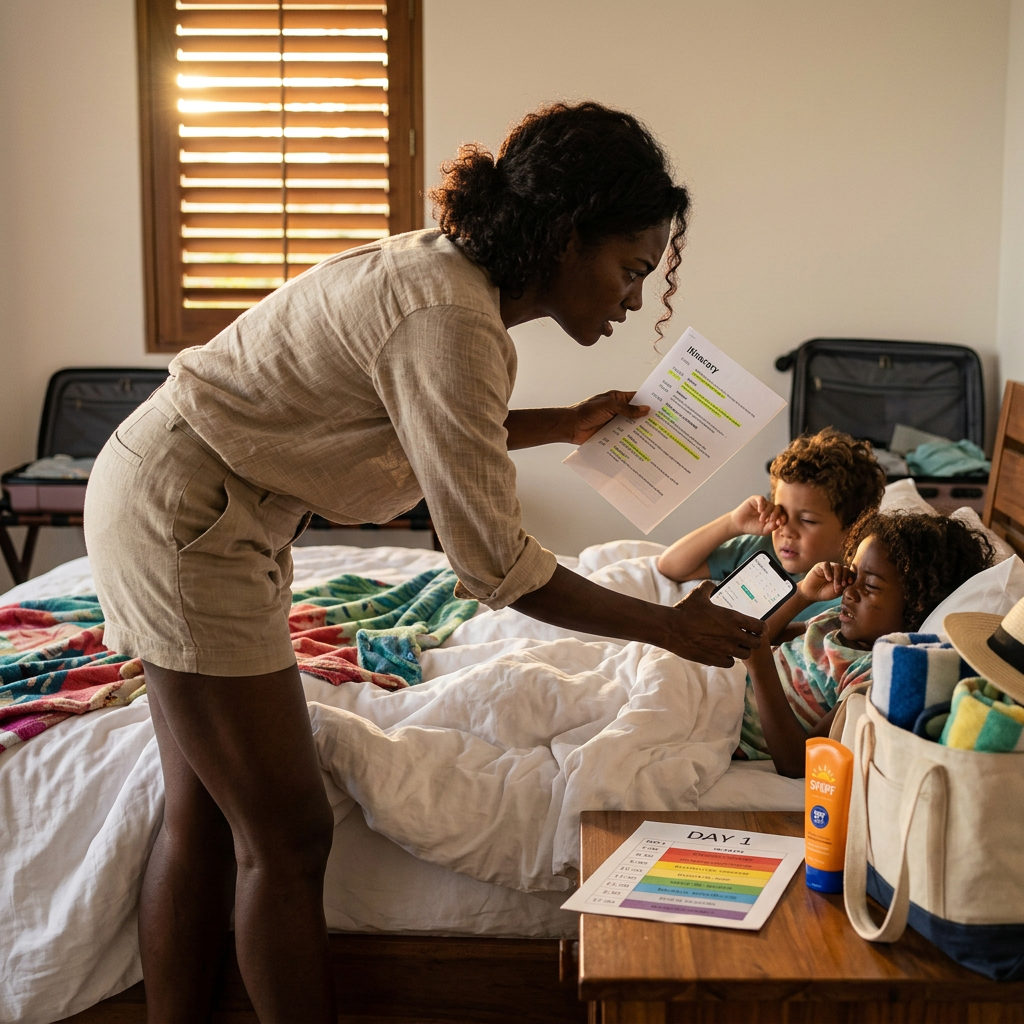
Or are you the person who books out your vacation itinerary with excursions and outings and tours and activities so it looks just like your regular life? You wake up early, getting the kids up like there’s school, to go kayaking and snorkeling. We have to be there by this time. We have to be there this long for the full experience. All the “have to’s”—no “get to,” and even worse, no “let’s just do this” or “let’s not do anything.”
The nervous system boarded a flight, swapped time zones, absorbed sunshine, yet never rested, never exhaled, could never just be.
Recovery Is Not the Same Thing as Escape

A lot of us think if we can just get away, recovery will automatically happen. But your nervous system travels with you. The same urgency that runs your workday can run your vacation. The same hypervigilance that keeps you prepared at home can keep you scanning for problems from a beach chair. The same need to stay informed, stay connected, stay useful, stay needed can follow you across state lines and international borders.
Recovery requires something different. It requires interruption. It requires allowing your body to experience moments where nothing is being demanded of it. No performance. No management. No fixing. No monitoring. No proving that you are responsible enough, productive enough, available enough, or important enough.
For some people, the hardest part of vacation is not leaving home. It is tolerating the discomfort of not being needed. Not checking the email. Not responding immediately. Not knowing what happened in the group chat. Not being the first person informed. Not controlling the outcome.
That discomfort is information.

It tells you where your nervous system has confused activity with safety.
It tells you where busyness has become an emotional regulation strategy.
It tells you where productivity has become identity.
What Happens When You Stop Doing?
Recovery asks a different question: What happens when you stop doing?
Not forever. Not irresponsibly. Just long enough for your body to realize there is no emergency.
Long enough to sit in silence without reaching for your phone.
Long enough to watch the ocean without documenting it.
Long enough to enjoy a meal without multitasking.
Long enough to let someone else handle it.
Long enough to remember that rest is not something you earn after exhaustion. It is something your body requires before exhaustion arrives.

 Chanda V Haynes
 Chanda V Haynes