
Encore: Do You Want More
And yet one line remains subjective: “Graduates are asked to conduct themselves in an appropriate manner that demonstrates respect toward fellow graduates, guests and the speakers on stage.” Graduates and guests are left to define ‘appropriate’ and ‘respect’ for themselves.

The West End opens in Chicago, at Chicago Technical Academy's graduation. The emcee calls “Tyvion Campbell” to the stage. At the front of a line of eager graduates, Tyvion reaches center stage, nods, smiles, and drops into a full split. Given her cheerleading background, it's not a far reach.
Back on her feet, she approaches the staff member handing out diplomas — the assistant. Beside the assistant stands another woman, one we'll later learn is the principal. The principal leans in and whispers something. The assistant responds by pulling the diploma close to her chest. Tyvion pauses, reaches again, confused like the rest of us watching, then realizes the assistant isn't going to hand it over. She exits the stage. On the floor, we watch security escort her out of the building.
Fast forward to Louisville, Kentucky — the Derby City, my hometown. Stuart Middle School's eighth grade graduation, the future class of 2030. Our eye is on Daniel Mattingly, the chosen student speaker. Daniel opens with jokes about being an angry gay kid with a mic. Then he goes off script from a speech approved only that morning. “This school is built on racism, sexism, and homophobia,” he says. “I encourage everyone here today to stand up for yourself, even if it makes a scene. This school is fucking ridiculous.” The auditorium explodes in applause and cheers — the room asking, without ever saying so, for more. Daniel exits the stage himself, mid-ovation.
The Setup
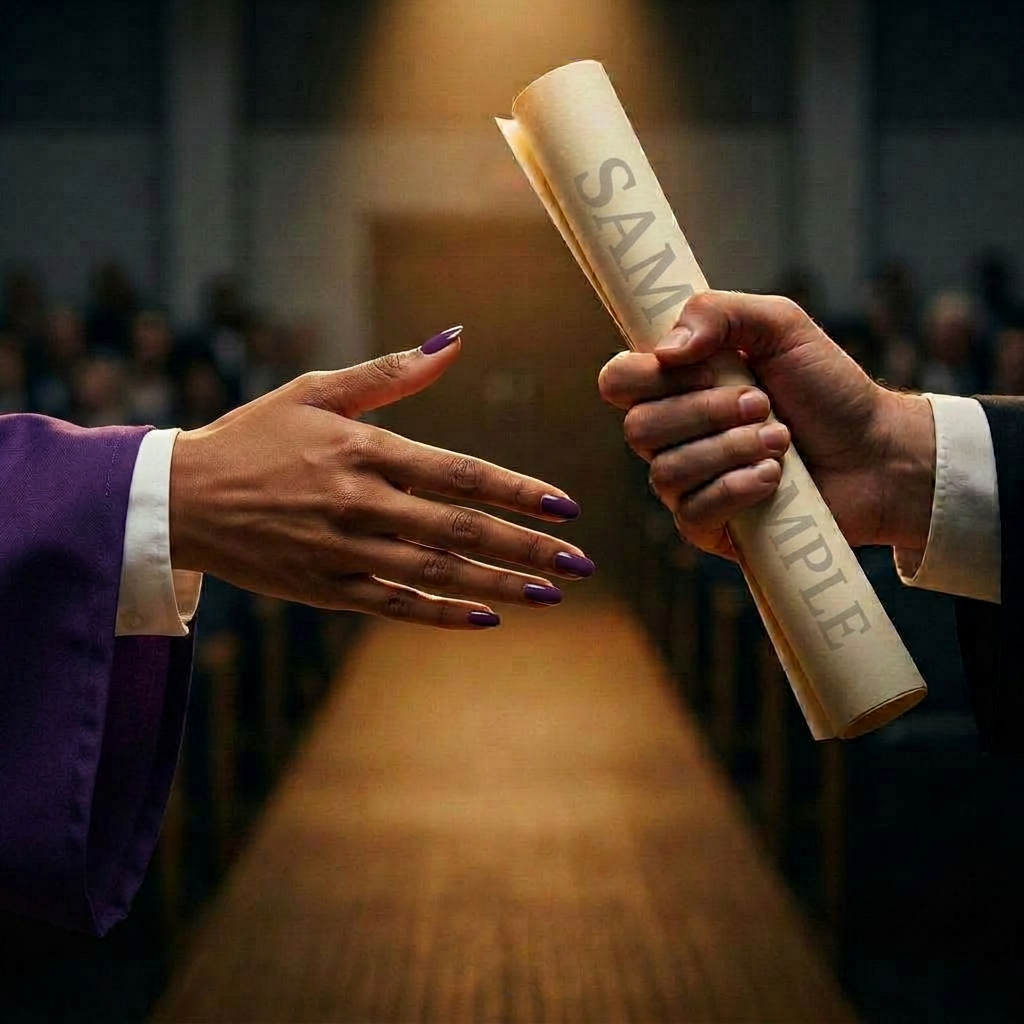
Tyvion is a Black eighteen-year-old graduate of Chicago Tech Academy. Per the academy, she completed all graduation requirements well in advance of the ceremony. She held a 3.5 GPA, cheered for Chicago Tech, and had already been accepted into Georgia State University, where she starts this fall. Daniel is a fourteen-year-old middle school graduate who describes himself as “an angry gay kid.”
Daniel's original approved draft, submitted weeks before graduation, included a passage about losing both of his parents during middle school — a detail school staff had reportedly encouraged him to include. By the morning of the ceremony, that passage was gone. What remained approved was safer: personal, but not political. The version Daniel actually delivered restored neither the grief nor the original ask for vulnerability — it replaced both with something the administration hadn't cleared at all.

What we witnessed at both ceremonies were two students who expressed themselves freely, regardless of whether the administration approved. The difference, per reports: Chicago Tech had no set rules, nothing explicit banning celebratory behavior — though some say Tyvion had hinted for weeks that she planned to do ‘something,’ and that she'd been warned she would be reprimanded if she did. Daniel, meanwhile, submitted multiple drafts of his speech and was told by Stuart staff that ‘there's a time and a place’ for that kind of speech, and this wasn't it. By his own account, his speech still needed edits the morning of the ceremony before finally receiving approval. He chose to go off script anyway — and spoke from the heart, or at least that was the majority's read. Others have suggested he never intended to deliver the approved version at all.
In this context, the point isn't Tyvion's race, gender, GPA, or age, nor is it Daniel's race, age, or sexual identity. The point is who decides the rules — regardless of whether the players are Black, white, high achievers, gay, or unpopular.
Who Decides the Rules?
California State University, Fullerton hands every student and family its rulebook on graduation etiquette (see Exhibit A).
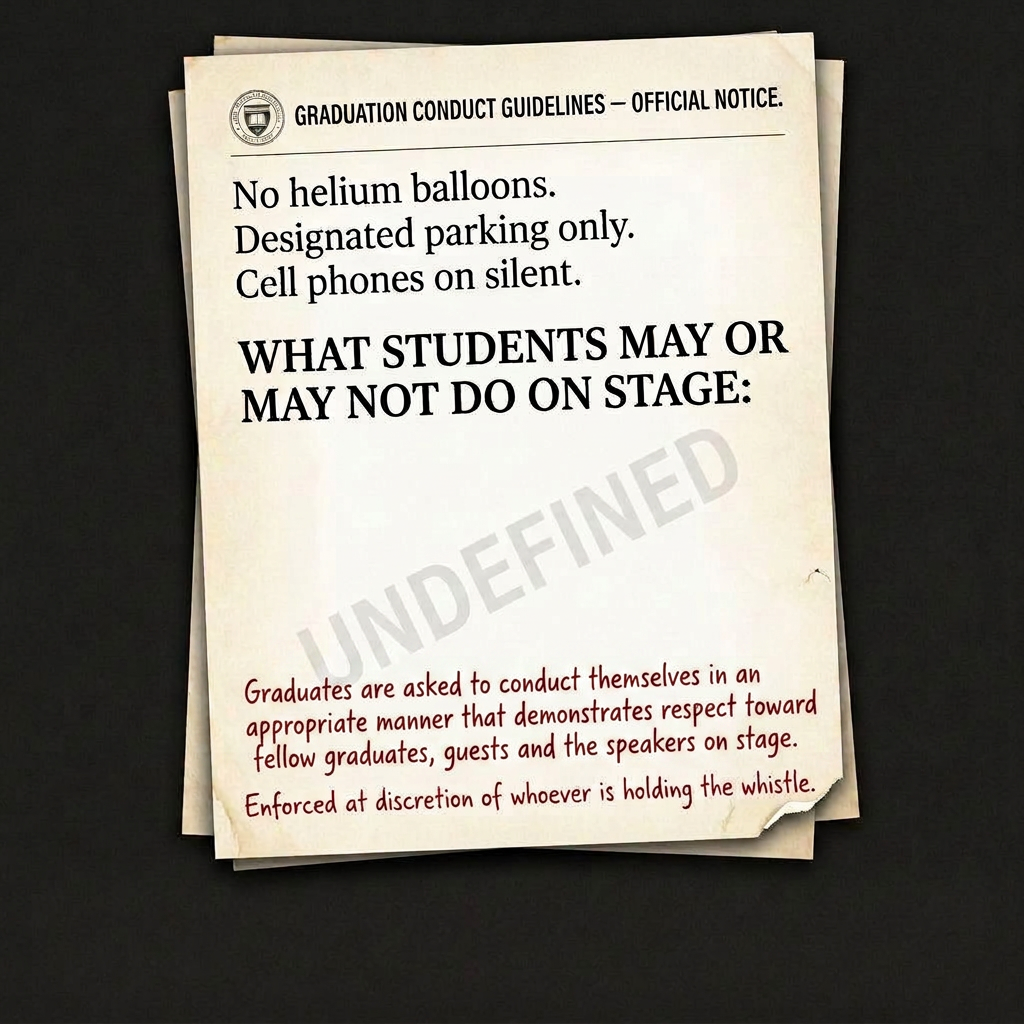
And yet one line remains subjective: “Graduates are asked to conduct themselves in an appropriate manner that demonstrates respect toward fellow graduates, guests and the speakers on stage.” Graduates and guests are left to define ‘appropriate’ and ‘respect’ for themselves.
CSUF is the exception, not the rule. Most schools — including the two in this story — don't offer a document that goes anywhere near this far, if they offer one at all. Chicago Tech and Stuart Academy were improvising in real time, and enforcement, or the lack of it, came down to whoever was calling the shots that day — and, to some degree, whoever felt disrespected.
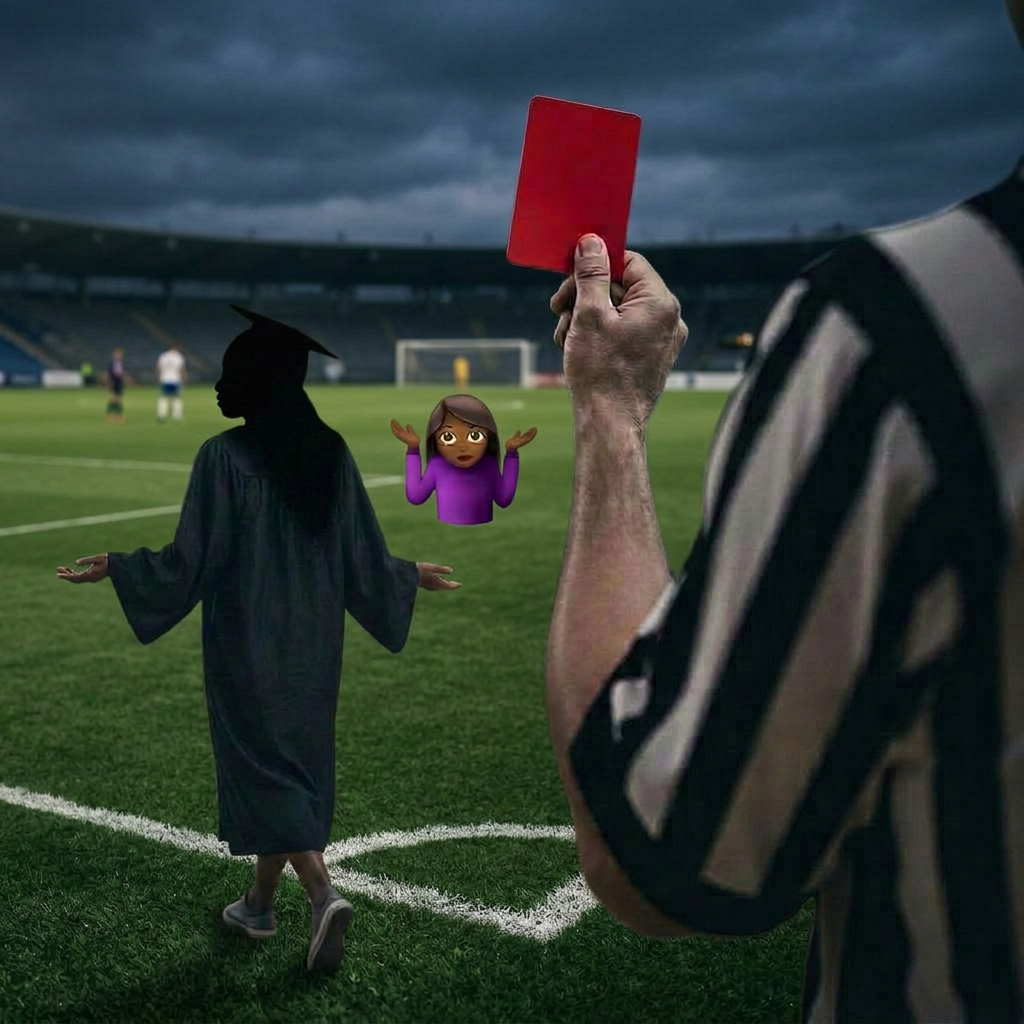
This is where implicit behavioral scripts play out on the field. For Tyvion, the referee was the principal. She blew the whistle, threw the flag, and made the real-time call that Tyvion had committed a foul — no review of the play, no consultation with other officials. The splits were never named a foul in any rulebook, but in that moment they were ruled not just a foul, but a flagrant 2: immediate ejection. Tyvion absorbed the penalty for an unwritten rule.
Daniel, by contrast, was warned pregame. He was told his speech would draw a flag for being ‘too provocative,’ that this version would cause ‘too much commotion’ among the other players (students), coaches (teachers), and fans (family and guests). Not allowed. His coaches may well have handed him the players' handbook on what would and wouldn't draw a foul. But when emotions run high, adrenaline spikes, and anxiety climbs, that handbook doesn't always make it to the frontal cortex. Or maybe Daniel simply didn't care.
We've seen this pattern recently in sports: Miguel Almirón during the FIFA Club World Cup, Tony Vitello of the MLB ejected just days ago, Draymond Green earlier this year. Each ejection followed a verbal altercation — words, not actions, that the referees judged unacceptable in the moment. And like Almirón's, Daniel's moment went viral. Many viewed Almirón's red card as excessive, given that he'd covered his mouth while delivering the expletive.
The Film Review: Tyvion vs. Daniel
TYVION CAMPBELL: THE SPLIT Action — Physical showboating (an end-zone dance)Ref reaction — Immediate red card, disqualification (diploma withheld, ejected)Psychology — Admin felt physically upstaged. The body taking up space read as defiance.
DANIEL MATTINGLY: THE SPEECH Action — Verbal technical foul (cursing at the institution)Ref reaction — Let 'em play, standing ovation, no immediate penalty Psychology — Verbal dissent gets processed through logic. Bystander paralysis set in the moment the crowd cheered.
One student showboated. The other committed a verbal technical foul. One received a red card and immediate ejection. The other received a standing ovation from players and fans alike. In practical terms, there's little left to do — neither will play for these teams again. But it is worth sitting with the discrepancy in how each was received, on and off the field.
Tyvion was ejected for behaving disrespectfully. Daniel was praised for his bravery in naming his own mistreatment. Public opinion split in both cases.
The Public Reaction Split
Tyvion's viral moment drew validation from the “she earned it” camp — arguments ranging from freedom of expression, to ‘why should she care, she's already done,’ to pointed questions about why women's bodies, Black women's in particular, keep getting policed. The “R-E-S-P-E-C-T” camp called her ‘too ghetto,’ ‘ready for the pole,’ an 'embarrassment' to her race and gender. Some went as far as to suggest that the school require her to repeat the twelfth grade.
It isn't just Tyvion — this year's graduation season overall has stirred a social media frenzy, with commencement compared to Carnival cruises, where there's been a reported uptick in violence, and to black funerals, where guests describe a persistent smell of marijuana in the air.
Daniel's fifteen minutes drew a parallel split. Some argued he had every right to self-expression, particularly as a bullying survivor; others pointed to the trauma of losing both parents during middle school as justification enough for his anger and his language. Others still voiced disdain for his language, his appearance, his sexual identity.
The Diaspora Rebuttal
The debate pulled in voices from Africa and the Caribbean, where commenters pointed out that dancing, celebration, even spraying a graduate with money, have always been part of the ceremony — some mocking Americans for being so ‘uptight’ about it. Where Western and European tradition prizes individual restraint in the name of the event's dignity, Afro-Caribbean and Indigenous tradition is rooted in communal triumph: one person's success is read as a win for the whole lineage.

Moving the Goalposts
There's another angle worth naming: leadership protecting its own reputation. When every eye is on your school or district, the stakes climb. Graduation is the most visible event on a school's calendar all year, and for an already underfunded school like Stuart Academy, negative attention risks more than embarrassment — it risks parents pulling bullied or underperforming kids out for somewhere else, and the funding that leaves with them.
The Practical Bind
Which raises the real question: who pays for enforcement? Is it the students, staff, and guests sitting through a longer ceremony while schools let the celebration play out before calling the next name? Is it the families whose child's name gets swallowed by someone else's applause — the video you took of your kid crossing the stage, the audio ruined by a reaction that had nothing to do with them?
The threat of waiting until Monday to collect your diploma doesn't carry much weight, either. Most of these students have already met every requirement. Transcripts have been mailed. And the cover handed out at the ceremony often doesn't even contain the actual diploma — it's a performative layer, public proof of what's already been earned, while the transcript did the real work weeks ago.
“Graduation decorum functions like a sports league with no standardized rulebook. While some institutional referees allow the game to flow freely, celebrating the emotional climax of a student's career, others enforce an authoritarian strike zone. This creates a psychological discrepancy where physical celebration — such as an end-zone dance — is met with immediate disqualification, while verbal infractions are granted immunity if the crowd provides enough social proof.”

Now can I get an encore, do you want more? The question got asked once in this story, and not with words — a room full of people stood up and answered it for Daniel before he'd even left the stage. Nobody asked it of Tyvion. There was no chant, no crowd deciding it wanted more of her. Just a whistle, a flag, and an exit.
So, who gets more?
Not talent. Not bravery. Not even the diploma — we've already established that's cardstock, a formality the transcript made irrelevant weeks ago. What's being distributed unevenly here is grace: the presumption, extended before a whistle is ever blown, that this player meant well. Daniel got that presumption retroactively, gifted to him by a crowd that decided for the refs what his foul was worth. Tyvion never got the chance to have a crowd decide for her — security had her out of the building before public opinion could organize itself into a defense.
Even CSUF, the one program in this story that actually printed a rulebook, couldn't legislate its way out of this problem. Somewhere in that document, between the clear-bag policy and the ban on helium balloons, is a single sentence asking graduates to be ‘appropriate’ and ‘respectful’ — two words the university never defines, because it can't. No handbook can. The strike zone gets called live, by whoever's holding the whistle that day, using whatever they walked in believing about which bodies get to take up space and which mouths get to be loud.
That's the part no rulebook fixes. You can write down the balloons. You can't write down the benefit of the doubt.