Show You How: The Anti-Culture of ‘Enough’

The Controlled Cadence: Friday Night Shifts
I remember many years ago, early in my mental health education and career, I would work the afternoon shift at a children’s psychiatric hospital. After spending the week managing bedtimes, facilitating intense processing groups, and chaperoning high-stakes community outings, your girl was tired.
So when Friday finally came, I’d literally secure the bag—the dime bag—right before my 2:00 PM shift. It would sit quietly in the center armrest of my Honda Accord until the overnight shift arrived to set me free. Leaving the facility in the dead of night, sometimes I’d swing by White Castle or Taco Bell to satisfy those classic late-night munchies.
When I finally got home, I rarely ventured back out into the world. It was time for a shower, Mary Jane, HBO, a Swiss Roll, and maybe a post-session, late-night visitor. If the bag was generous, I’d roll two thin blunts in Swishers—I never liked the big fat ones. I’d puff one down halfway, put it out, watch some TV, make a phone call, and completely immerse myself in my own world for the night.

The next day, I would go about standard weekend life. I’d shop, see friends and family, get my groceries, and maybe hit a club. If someone else had weed at the function, I might hit it. But whenever I returned to my apartment, my little stash was waiting. Even after clubbing and drinking all night, I’d come home, puff once or twice, and be comfortably zoned. Sunday night was no different. Even though I was expected back at the hospital on Monday, it was the second shift. I had a window. It was a controlled, predictable cadence.
The Shift: The Culture of Excess
But then, a shift occurred. My schedule changed. I went back to school and suddenly found myself with free daytime hours and long breaks between classes. I had friends living near campus, so I started pulling up on them between lectures or whenever the school day wrapped.
That was when I realized they smoked weed all day. Not just as a wind-down ritual at night, but as a continuous state of being. I learned what “wake and bake” actually meant—they were sparking up while still laying in bed. It was an entirely different cadence.
Gradually, I adapted to their rhythm and smoked more. I traveled with them. We smoked in the cars, we smoked in the clubs, and we smoked after the clubs. We smoked and smoked and smoked. And every single time we sessioned, we smoked it all. We only stopped when the blunt physically burned down to a roach. We only stopped when the sack was completely empty. If we ran out, someone always had a connection or knew exactly how to get more.

Now, we weren’t “potheads” in the traditional sense; we were functional, working, educated people who simply loved weed whenever we could get it. Friends would say, “Come smoke with me,” and we’d finish a blunt. “Come match,” and we’d burn through two. The session never ended because we were satisfied; it only ended when the supply was completely exhausted.
The Forgotten Boundary of Enough
What these two eras of my life expose is a glaring design flaw in our relationship with consumption. These two distinct patterns have a clinical name: Microdosing vs. Institutional Excess. Microdosing is the intentional consumption of the absolute smallest amount needed to achieve a therapeutic effect without reaching full intoxication. The goal isn’t escape—it’s relief. The goal isn’t clouds—it’s clarity.
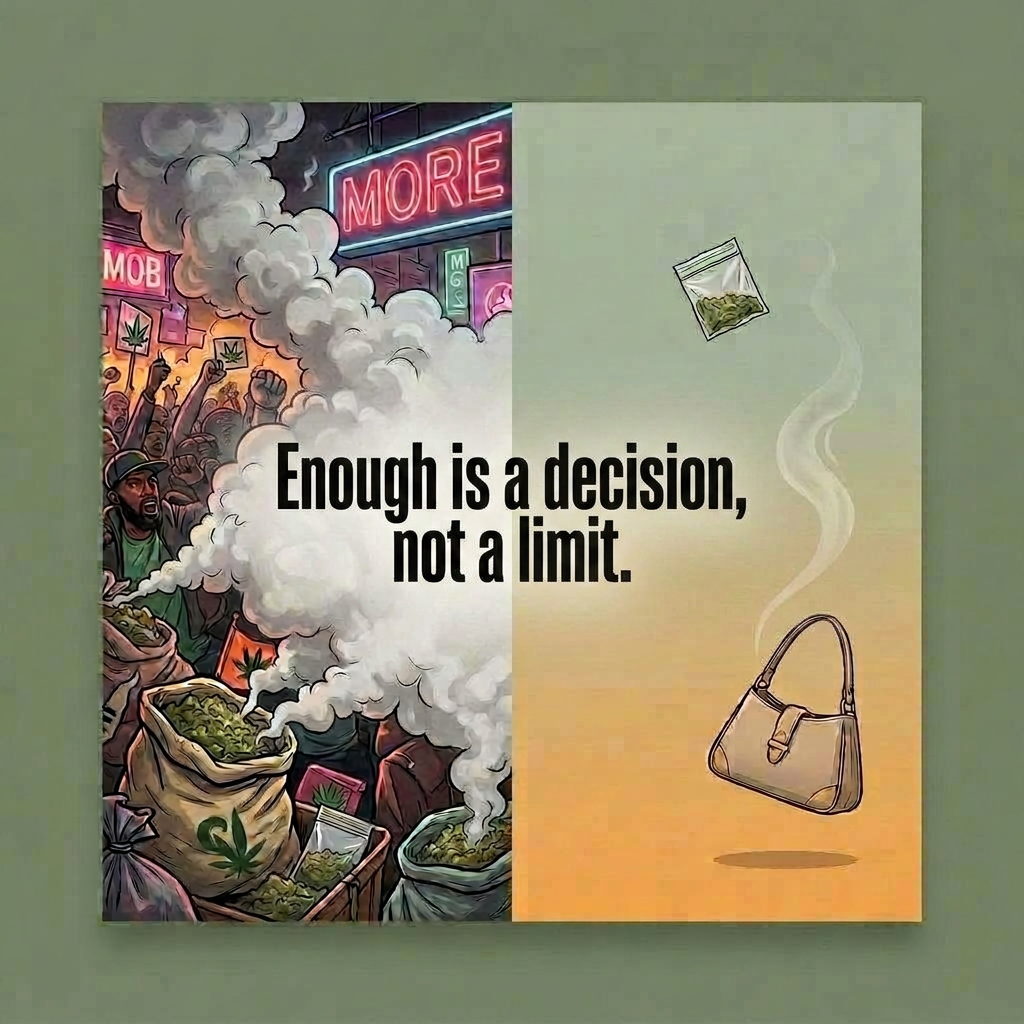
The problem is that most people don’t even know you can microdose cannabis, especially the smokables like joints and blunts. The culture never showed us how. Jay-Z laid out the raw mechanics of modern distribution on the track, rapping:
"...put a little in the purse"
While he was talking about the street-level economics of supply, the psychological reality of that line is the ultimate blueprint for somatic recovery. It’s an instruction for containment. True moderation requires you to physically separate your immediate need from your total inventory. It means you don’t bring the whole stash to the session. You take a fractional piece, put it aside, and leave the rest behind.
Look at how we approach alcohol. Society models a built-in architecture for moderation: you have a single glass of wine to unwind, or a shot or two after a long week. Usually, if people drink a whole fifth of liquor, it isn’t intentional—it’s purely an accident of the night getting away from them. Nobody sits down at a table saying, “I am going to finish this entire fifth tonight. Let’s drink until it’s completely gone.” (Perhaps an alcoholic does, but the general public does not.) They typically have their drink and return the bottle to their liquor cabinet, or they order two or three drinks at a lounge. The default setting is never, “Keep ‘em coming until the establishment runs completely dry.”
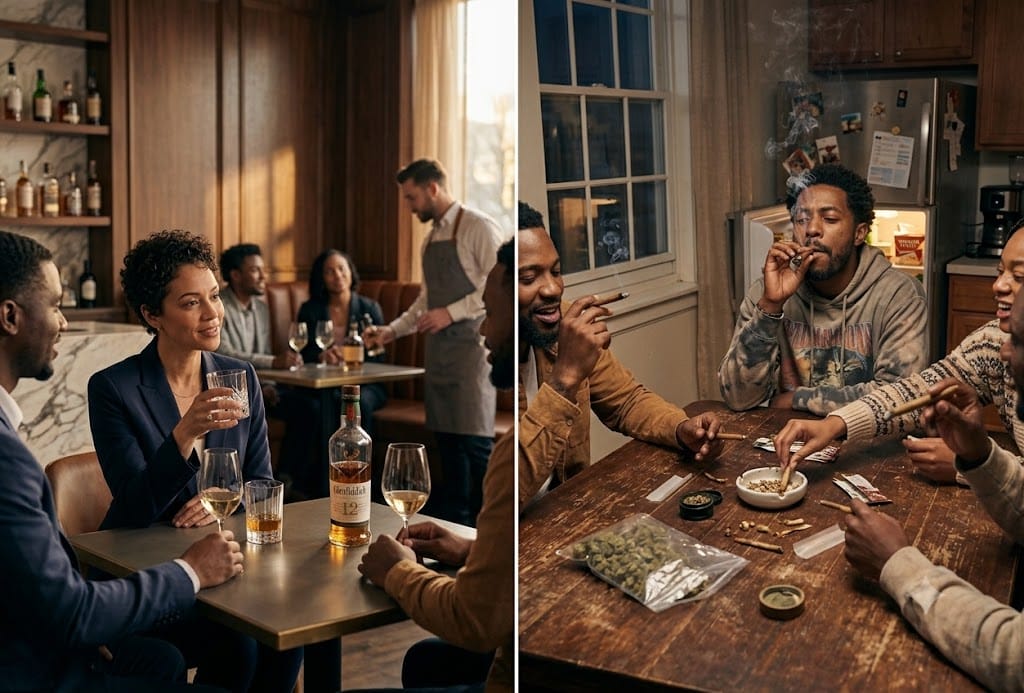
Cannabis, however, has never been modeled that way. The culture dictated that you consume the whole blunt, the whole joint, the whole sack. If you tried to put your blunt out halfway, you were immediately labeled stingy, cheap, or not a team player. There was always that ambient cultural pressure: “We might as well finish it. That little piece won’t do you any good anyway.”
But as a practitioner, I am here to tell you that that little piece is exactly what gives the teacher what she needs to relax her nervous system for the evening. That little piece is what allows the hyper-vigilant executive to turn off his racing thoughts and just be.
The Accidental Blueprint
There’s a second, stranger piece of evidence for all this, and it shows up somewhere nobody designed it to: vaping.
When people vape cannabis, microdosing often happens without anyone teaching them to do it. Nobody sits and puffs a vape continuously for twenty minutes straight in a single session. Nobody consumes a whole cartridge in one sitting. Instead, they take a single pull here and there throughout their day. They keep it on their nightstand, take two pulls, and turn over to sleep.
Part of this is biological—vape oil is far more concentrated, so the body corrects fast. But the larger part is psychological, and it’s the more interesting part: we were never culturally conditioned to linger with a vape the way we were with a blunt. Most people’s introduction to vaping was a random hit off someone else’s device. You hit it, choked at how concentrated it was, maybe took one more puff, and passed it back. That was it.
Because there was no cultural blueprint or rap song dictating what the “vape equivalent of a whole blunt” looked like, people were forced to rely entirely on their own internal, biological signals. They had to know when they felt good or had enough. Because the delivery system was new and unfamiliar, they naturally treaded lightly—not through modeling, not through peer pressure, and certainly not through music, but through trial, error, and internal awareness.
In other words: where there was no culture telling people how to consume, their bodies built the boundary on their own. That’s the accidental proof of everything this essay is arguing—moderation isn’t unnatural. It’s just been culturally overridden.
To recover from the anti-culture of excess, we have to stop letting the crowd dictate the end of the session. True sovereignty means pulling back the curtain, finding your own microdose, and realizing that sometimes, a half-puff is more than enough to set you free.